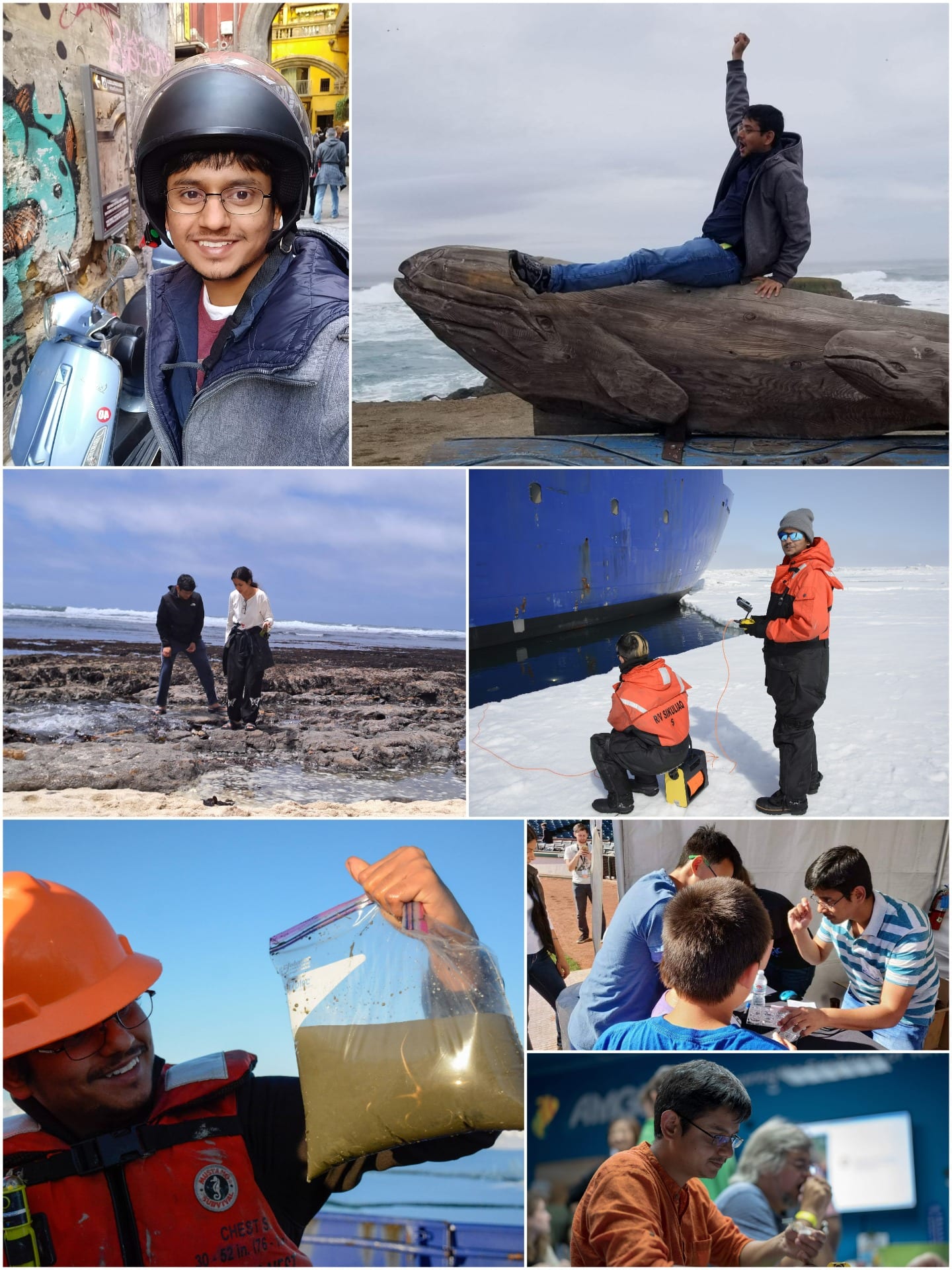
I am a Helen Hay Whitney Foundation postdoctoral fellow at the Center for Living Systems and the Department of Molecular Genetics & Cell Biology at the University of Chicago, where I work with Dr. Noah Mitchell on multicellular biomechanics and Dr. David Pincus on cellular stress responses. I joined through the Biological Sciences Division’s Chicago Fellows Program.
My work centers on a single question: how does collective organization emerge, and what makes it hold? A developing embryo assembles one every generation; an evolving lineage assembles one for the first time. I am interested in the moment a group of cells stops behaving like a group and starts behaving like a thing — and in what keeps it there afterwards.
What I work on
Using Drosophila and experimentally evolved multicellular yeast as complementary model systems, I study the emergence and stabilization of collective organization across developmental and evolutionary timescales — the same transition watched on the timescale of an embryo and on the timescale of a lineage.
In parallel I am developing theoretical frameworks for the evolution of complex multicellularity, and for the emergence of higher-order organization in society. The second is less a metaphor for the first than the same question asked of a different substrate. It is also practical: I have been building Citizen School Record, an online platform for citizen-driven audit of public schools in India, and speaking on whether we might become a planetary adaptive society — emergence, social learning, and the next architecture of democratic coordination.
What I worked on before
During my Ph.D. with Dr. Manu Prakash at Stanford, I studied how juvenile sea cucumbers build ossicles — roughly 100 μm calcite skeletal elements, strikingly diverse in form, assembled inside syncytial multicellular pockets. Combining live imaging with electron microscopy, I showed that a membrane-bound cytoplasmic sheath envelops the growing mineral and drives tip extension, branching, and fusion through surface-confined cytoskeletal activity. Abstract models of self-closing active networks reproduce the growth motifs and suggest rules that govern the diversity of final shapes.
In parallel I worked on placozoa, an early-diverging animal with an organ-less, essentially two-dimensional body plan. High-throughput imaging revealed scaling laws linking size and shape fluctuations to splitting events, backed by computational models of 2D tissue growth.
Fieldwork has shaped how I think. On a 2023 Arctic expedition aboard the RV Sikuliaq, I came across dense brittle star assemblages beneath the sea ice of the Chukchi Sea. These arm-linked, disordered networks stretch for kilometers and show suppressed density fluctuations — a signature of hyperuniformity. We are modeling how that collective spatial order emerges from simple rules of interaction, symmetry, and population dynamics.
Alongside the core research I have contributed to open tools: the SQUID platform for quantitative imaging in low-resource settings, and a low-cost centrifugal melt-spinning system for PPE filtration media, co-led during the COVID-19 crisis.
Where I’m going
The thread running through all of it is how new layers of biological individuality emerge and then get stabilized — how a collection of parts acquires interests of its own, and why that arrangement persists instead of coming apart. Longer term I hope to build a group that combines soft-matter physics with evolutionary cell and developmental biology to ask that question properly, at both the timescales it plays out on.
Before
I completed a dual B.Tech–M.Tech in Mechanical Engineering at the Indian Institute of Technology Kanpur, working with Dr. Sovan Das on soft matter, Dr. Anupam Saxena on robotics, and Dr. Amitabha Bandyopadhyay on developmental biology.
I found my way into biology sideways. As an undergraduate mechanical engineer I stumbled on D’Arcy Thompson’s On Growth and Form — the art of describing patterns across living systems with arguments rooted in physics. I started collecting samples from around me and putting them under a microscope, and I have been following that thread since. I try not to let my existing skills decide which questions I am allowed to ask.
I grew up in Udaipur, Rajasthan, in a family of school teachers — which is probably why teaching keeps pulling me back. I built and taught a short course on Differential Geometry for Biologists at Stanford, and TA’d the MBL Physiology course at Woods Hole. I play the bansuri as an amateur student of Indian classical music, and I take photographs; both keep me attentive to improvisation and to the patterns that living things keep producing.
Feel free to get in touch, especially if any of this overlaps with what you work on.